The proprietary trading industry has grown rapidly, attracting new firms, expanding into different asset classes and introducing a wider audience to funded-trader programmes. But greater competition is creating difficult questions about how these businesses manage risk, differentiate their products and maintain traders’ trust.
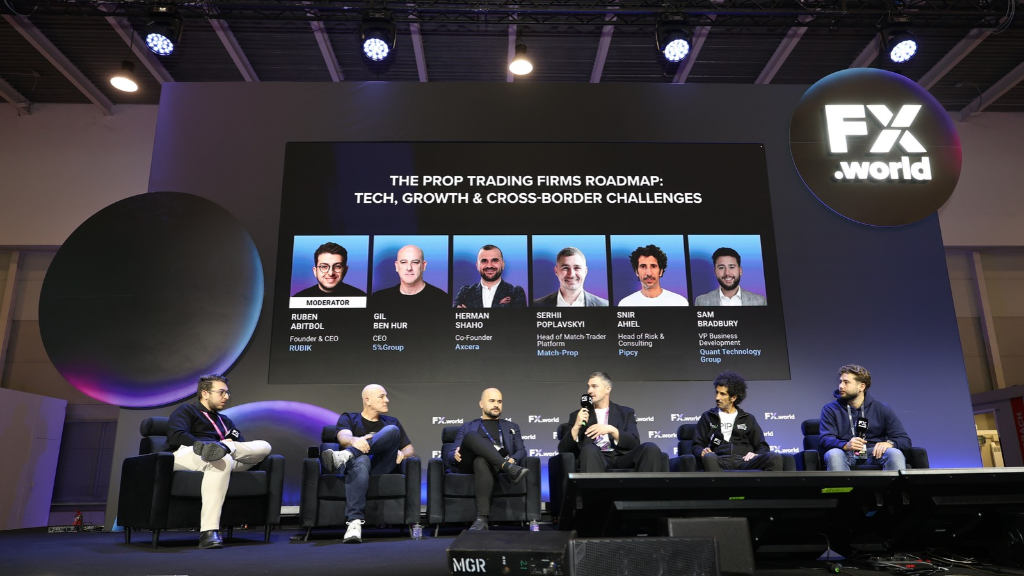
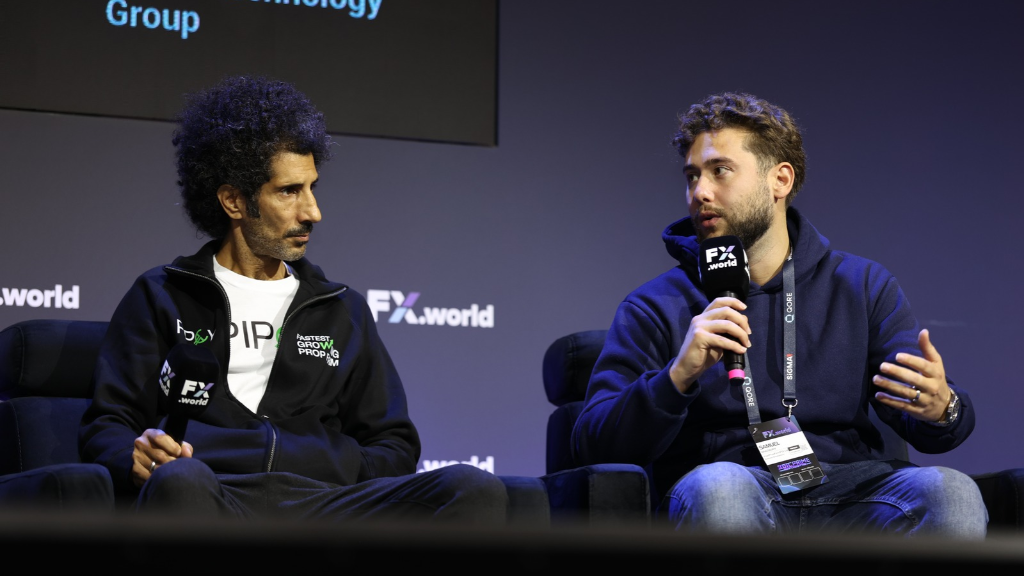
Those challenges took centre stage during The Prop Trading Firms Roadmap: Tech, Growth & Cross-Border Challenges, held on 4 November at the Global Finance Stage during FX World, which took place in Rome in November 2026.
Moderated by Ruben Abitbol, Founder & CEO of RUBIK, the panel brought together Gil Ben Hur, Founder of 5% Group; Herman Shaho, Co-Founder of Axcera; Serhii Poplavskyi, Head of Match-Trader Platform at Match-Prop; Snir Ahiel, Head of Risk & Consulting at PIPCY; and Sam Bradbury, VP of Business Development at Quant Technology Group.
The discussion explored how prop firms are evolving alongside traditional brokers, why expansion into new markets and instruments requires careful planning, and how artificial intelligence and social media are changing both internal operations and customer acquisition.
Prop firms and brokers: Competitors or complementary businesses?
The panel began by examining the relationship between proprietary trading firms and CFD brokers.
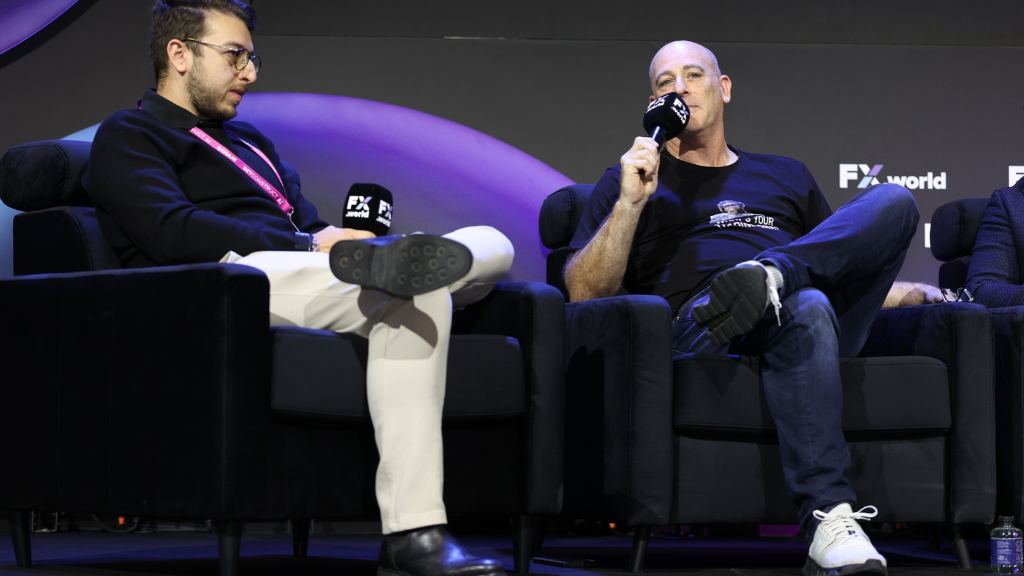
Rather than viewing the two sectors as direct competitors, Gil Ben Hur described prop firms as a complementary route into financial markets, particularly for people with limited trading experience.
Funded-trader programmes can offer newcomers a way to explore trading strategies without committing the same level of personal trading capital that might be required elsewhere. Community features, educational resources and structured challenges can also help participants develop their knowledge.
However, limited initial financial exposure does not eliminate the risks associated with trading, nor does it guarantee that participants will progress to more advanced services.
The speakers also noted an increasing overlap between the two business models. Some brokers have introduced prop trading operations, while certain prop firms have explored opportunities in brokerage.
For established financial services companies, the distinction may therefore become less important than understanding which products serve different customer needs.
The panel suggested that prop firms could continue to function as an entry point for newer traders, while brokers and technology providers adapt their services to reach overlapping audiences.
Multi-asset expansion creates opportunities and new risks
The next question concerned diversification beyond traditional CFD-based prop trading.
Futures, cryptocurrencies, perpetual contracts and tokenised assets are attracting attention as firms seek to broaden their offerings and distinguish themselves from competitors.
Sam Bradbury linked this development to growing competition within the prop trading market.
As more companies offer similar challenge structures, finding meaningful differences between products becomes increasingly difficult. Introducing new instruments can provide another way to attract traders, particularly those who prefer markets or trading conditions not covered by existing programmes.
The panellists also considered the geographical dimension of diversification. Customer preferences vary between regions, and expanding the available asset classes may help firms reach audiences that would not otherwise consider their services.
However, the discussion made an important distinction between established operators and newly launched businesses.
Companies with mature operations, sufficient resources and experienced teams may be better positioned to offer several asset classes. Startups attempting to do too much at once risk introducing complexity before they have developed the systems needed to manage it.
Different instruments also demand different approaches to pricing, monitoring and risk control.
The conclusion was not that every prop firm should become multi-asset. Instead, diversification needs to match the company’s expertise, resources and stage of development.
Risk management is becoming the defining challenge
Risk management emerged as the central issue of the discussion.
The speakers argued that prop firms face a different set of operational risks from conventional brokers.
While brokerage risk often focuses on execution and market exposure, prop firms must also consider challenge structures, trader behaviour, rule violations, potentially abusive strategies and the sustainability of their programmes.
Gil Ben Hur highlighted the importance of understanding a firm’s customers and examining trading data to identify patterns that could threaten the business.
Those risks can evolve quickly. A policy that works under one set of market conditions or customer behaviours may need adjustment as the company grows.
Competition has made the problem more complicated.
In an effort to attract customers, some firms have reduced trading restrictions, removed consistency requirements or introduced more generous challenge conditions. Such changes may strengthen a company’s marketing proposition but can also make its risk model harder to manage.
The panel stressed that growth cannot compensate indefinitely for an unsustainable challenge structure.
Technology providers can supply analytics, reporting and tools for identifying suspicious behaviour. However, the responsibility for establishing suitable policies remains with the operator.
The discussion also highlighted the importance of transparency.
Rules must be commercially viable, but they should also be understandable to traders. Ambiguous restrictions and unexpected enforcement decisions can undermine confidence in a firm’s programme.
For an industry still developing common operational practices, balancing competitive offers with consistent and transparent risk management is becoming increasingly important.
AI can identify trading patterns, but should it make the decisions?
Artificial intelligence provided another major theme, particularly its potential to process trading data and identify unusual behaviour.
The panellists discussed how AI-powered systems can help risk teams analyse large datasets, detect patterns that may be difficult to recognise manually and reduce repetitive operational tasks.
Herman Shaho emphasised the value of AI in supporting analysis and automation, while also acknowledging that these capabilities do not eliminate the need for human judgement.
The discussion explored how technology could help smaller teams oversee larger operations, potentially making sophisticated monitoring tools more accessible.
However, several speakers warned against relying too heavily on automated decisions.
AI can generate alerts and identify potentially problematic activity, but operators still need to investigate the findings and determine how to respond.
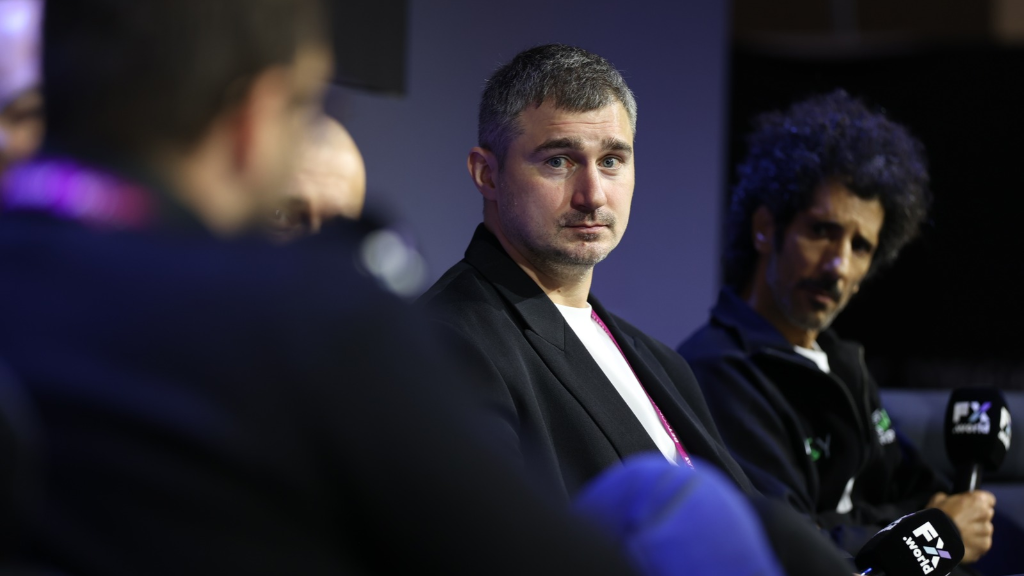
Sam Bradbury also cautioned against excessive dependence on AI across business functions, noting that companies sometimes use automated tools without sufficiently considering whether they improve the final result.
Gil Ben Hur offered another perspective: personalisation.
Rather than grouping traders into broad customer segments, AI could allow prop firms to develop services around individual trading behaviour, experience and preferences.
The same analytical capabilities could support more tailored risk monitoring.
Yet this creates another challenge. As firms adopt AI to identify unusual activity, traders and other market participants may also use increasingly sophisticated tools.
The speakers acknowledged that the long-term consequences remain uncertain, particularly for an industry in which trading skills and individual performance are central to the business model.
Social media is now part of the prop trading customer journey
The final part of the panel moved from technology and operational risk to marketing and reputation.
Social media has become an important channel for prop firms, influencing not only how traders discover new companies but also how they evaluate their credibility.
Bradbury described the value of maintaining a visible presence beyond paid advertising, including sharing everyday business activities and giving prospective customers a better understanding of the people behind a brand.
Influencers and industry communities can also introduce firms to audiences they might struggle to reach through traditional marketing.
However, the speakers argued that visibility alone is not enough.
Ben Hur explained that traders increasingly turn to social platforms to understand challenge programmes, compare providers and assess the experiences of other customers before making a purchase.
As a result, much of the decision-making process can take place outside a company’s website.
For newer firms, this creates an opportunity to build credibility through consistent communication and positive customer experiences.
It also introduces considerable reputational risk.
Complaints, disputed decisions and allegations can spread rapidly through online trading communities. An isolated controversy may affect confidence far beyond the customers directly involved.
The discussion suggested that prop firms need to consider social media as part of their wider business strategy, rather than treating it solely as an advertising channel.
Clear policies, responsive communication and transparent treatment of traders can be just as important to a firm’s reputation as its marketing campaigns.
The future of prop trading depends on sustainable growth
Although the panel covered technology, diversification and customer acquisition, the discussion repeatedly returned to the importance of building businesses capable of managing their own growth.
New trading instruments can attract additional audiences, but they also introduce unfamiliar risks. AI can improve monitoring and operational efficiency, yet human oversight remains essential. Social media can accelerate customer acquisition, but it can expose firms to equally rapid reputational damage.
The panel also demonstrated that prop firms cannot rely on technology alone to overcome these challenges.
Sustainable challenge structures, experienced teams, transparent rules and a clear understanding of customer behaviour remain fundamental to long-term operations.
As the industry develops, the companies best positioned to compete may not necessarily be those offering the widest range of instruments or the most attractive promotional conditions. They may instead be those capable of combining innovation with consistent risk management and credible customer relationships.
The conversation around proprietary trading, technology and the future of financial markets will continue at FX.world Rome in May 2027. Further details about the revised event calendar are available in the official announcement.