Payment orchestration promises to simplify an increasingly fragmented financial ecosystem, but can it replace the need for multiple providers? At FX.world Rome 2026, industry experts examined the commercial benefits, operational risks and technological limits of unified payment platforms.
One integration, multiple payment methods and access to different markets: the promise of all-in-one finance is appealing to merchants looking to simplify their operations. Yet behind a single interface lies a network of payment providers, acquiring relationships and regulatory requirements that cannot always be consolidated.
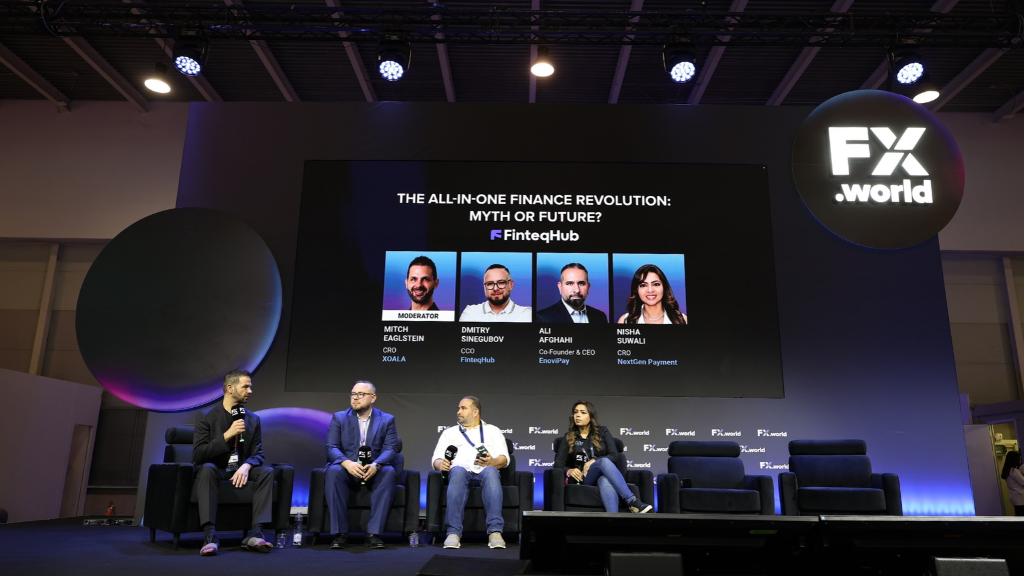
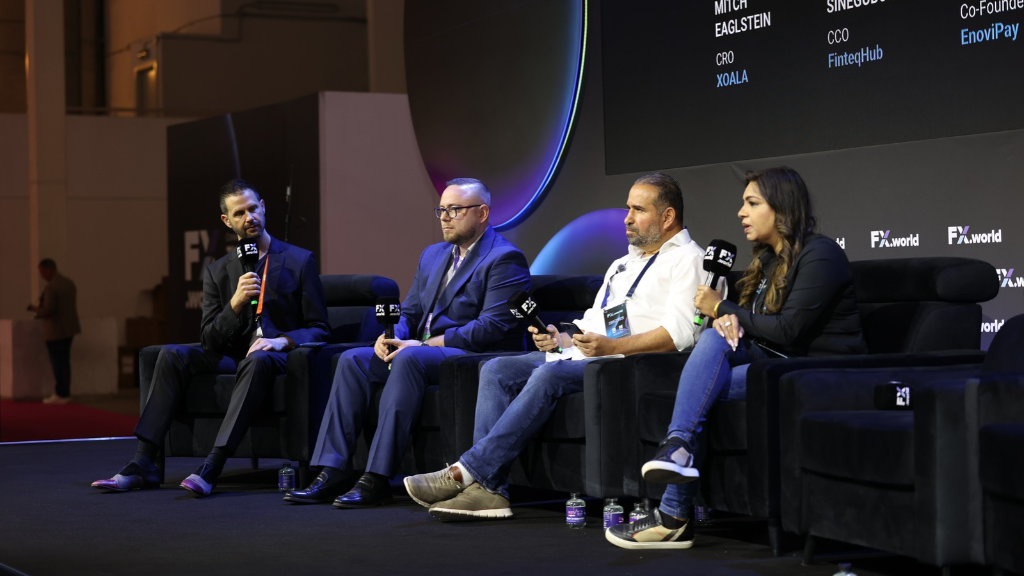
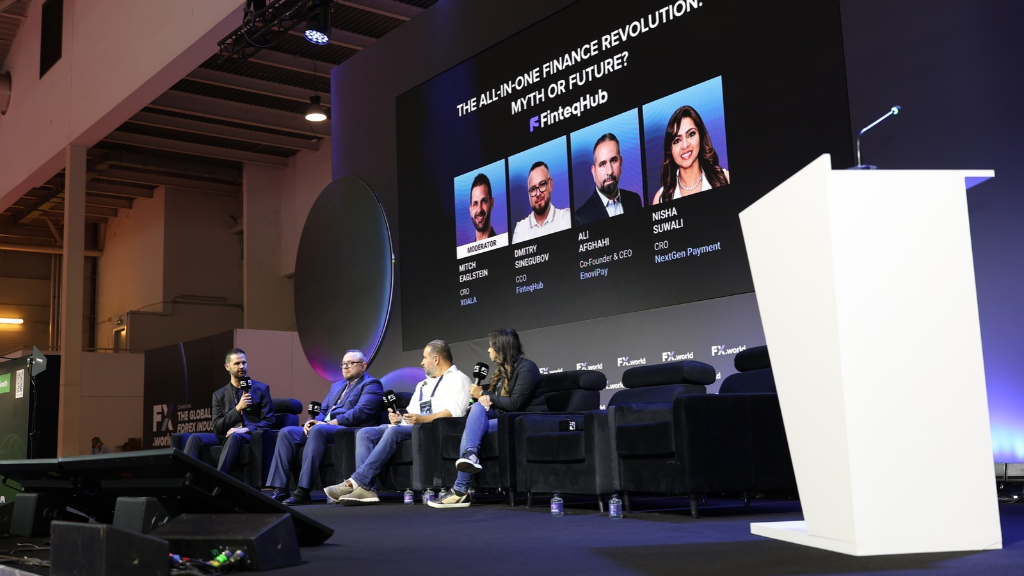
This distinction shaped The All-in-One Finance Revolution: Myth or Future?, a panel held on 4 November at the Global Finance Stage during FX.world held in Rome, on November 2026.
Brought to the stage by FinteqHub, the discussion was moderated by Mitch Eaglstein, CRO at XOALA, and featured Dmitry Sinegubov, CCO at FinteqHub; Ali Afghahi, Co-Founder & CEO at EnoviPay; and Nisha Suwali, CRO at NextGen Payment.
While the speakers largely agreed that payment orchestration can simplify complex operations, they differed over when it becomes commercially worthwhile and whether a genuine one-stop solution can exist across multiple jurisdictions.
One API does not eliminate the need for multiple providers
The panel opened by asking what an all-in-one payment solution should actually deliver.
For Sinegubov, whose company operates in payment orchestration, the defining feature is a single API through which merchants can access different payment methods and providers. Rather than replacing the underlying financial infrastructure, orchestration connects its components through one integration.
Afghahi approached the question from the merchant’s perspective, emphasising the value of reducing operational complexity through a single contract, one know-your-customer (KYC) process and a unified technical connection.
Suwali offered a more cautious assessment. A complete payment solution, she argued, must account not only for technology but also for acquiring, local payment methods, fraud prevention and risk management.
These requirements become particularly important when merchants expand into new jurisdictions.
An acquiring partner that provides competitive approval rates in one country may not deliver the same performance elsewhere. Local licensing requirements, regulatory differences and consumer payment preferences can also influence which providers a business needs.
Suwali therefore distinguished the technology layer supplied by an orchestrator from the acquiring relationships that merchants must establish separately.
Sinegubov agreed that a single provider cannot necessarily satisfy every requirement in a new market. Orchestration, however, allows merchants to bring different services together without building individual integrations for each one.
Higher approval rates can outweigh orchestration costs
The discussion then turned to payment conversion, particularly for businesses operating in forex, CFD trading and iGaming.
For these merchants, the customer journey can be interrupted when a transaction falls outside a provider’s risk appetite or when the available payment methods do not match local customer preferences.
Afghahi argued that merchants investing heavily in customer acquisition cannot afford to overlook payment approval rates. A customer who reaches the deposit stage but cannot complete the transaction represents a commercial loss, regardless of the effectiveness of the preceding marketing activity.
From his perspective, payment service providers (PSPs) and orchestrators fulfil complementary roles.
A merchant may need relationships with several PSPs to secure the appropriate acquiring coverage, while an orchestration platform can manage transaction routing across those providers.
Suwali highlighted further advantages, including consolidated reporting, transaction analytics and access to integrated fraud and risk management tools.
Orchestration can also reduce the technical workload associated with maintaining several payment integrations.
The additional technology layer comes at a cost, however. Afghahi considered that expense justifiable when improved payment conversion offsets it, particularly in sectors where acquiring customers is expensive.
Whether the same calculation applies to smaller businesses proved more contentious.
Do startups need payment orchestration from day one?
One of the clearest differences between the panellists emerged when Eaglstein asked whether orchestration makes sense for a small business operating in a single market.
Sinegubov argued that startups may have an even greater need to outsource payment complexity because they lack the resources to build and maintain multiple integrations internally.
Afghahi agreed, observing that larger forex and CFD brokers can employ dedicated payment teams, while smaller companies often need external partners to manage operational requirements.
Suwali questioned whether the additional expense is always justified at an early stage.
A newly established merchant operating in one market may not need the full range of routing, reporting and risk management capabilities offered by an orchestrator. In those circumstances, selecting a suitable payment provider with a clear understanding of the business may be more important.
As companies grow and enter additional markets, the commercial case for orchestration becomes stronger.
The disagreement highlighted a fundamental consideration: the value of a unified payment platform depends on the merchant’s size, operating model and geographical ambitions.
AI is improving payments, but human oversight remains essential
Artificial intelligence emerged as another factor influencing the development of payment orchestration.
Sinegubov explained that AI is already being used to analyse transaction data and optimise payment routing rules. These applications can support more efficient decision-making, although he stressed the importance of expert oversight before changes are implemented.
Suwali pointed to AI-assisted document verification as an example of how acquiring institutions are using automation to accelerate merchant onboarding.
Afghahi also highlighted applications in fraud management and transaction routing, where the ability to analyse large volumes of information can improve operational efficiency.
The speakers did not suggest that AI could independently manage every aspect of payment processing.
Instead, the discussion presented automation as a means of supporting existing financial operations, with human judgement and appropriate safeguards remaining important.
Why orchestrators are unlikely to replace acquirers
The relationship between orchestrators and acquiring institutions provided another test of the all-in-one model.
Could orchestration companies eventually become acquirers themselves, combining technical integration with direct payment processing?
Suwali emphasised that the two businesses carry fundamentally different responsibilities.
An orchestrator primarily provides technology, whereas an acquirer must also manage settlement, card scheme obligations, regulatory compliance and financial risk.
Combining those functions could introduce another concern: whether an orchestrator with its own acquiring business would continue to route transactions impartially among competing providers.
Afghahi similarly argued that becoming an acquirer is not a necessary step for orchestration companies. The two activities require different expertise and operational structures.
Sinegubov did not rule out orchestrators adding acquiring capabilities, but acknowledged that doing so would require maintaining fair treatment of external partners.
For merchants, this distinction matters because access to multiple acquiring relationships can provide both flexibility and protection against disruption.
Multiple acquiring relationships offer protection against sudden disruption
The risks of depending on a single provider became particularly apparent when the discussion turned to merchants losing access to payment services.
A provider may change its risk policies, withdraw from a particular sector or terminate a commercial relationship. For businesses relying entirely on that provider, the consequences can be immediate.
Suwali argued that merchants should maintain an acquiring strategy that allows them to move transactions between providers when circumstances change.
This is especially relevant in sectors where risk appetite can shift over time, including gaming and trading.
Afghahi supported the need for multiple providers, even when a merchant has an established relationship with one PSP.
Orchestration can make that flexibility easier to manage, but it does not remove the importance of choosing suitable acquiring partners in the first place.
Licensing could drive the next wave of payment consolidation
Looking beyond individual merchant requirements, Afghahi predicted further consolidation among payment service providers.
He linked this possibility to the expansion of online payments and the growing importance of geographical coverage.
Obtaining licences and establishing operations in multiple jurisdictions can be complicated and expensive. Acquiring companies with existing regulatory permissions could therefore offer PSPs a route into additional markets.
Afghahi suggested that consolidation may help providers broaden their geographical reach and offer merchants a more comprehensive range of services.
The discussion reinforced the distinction between consolidating access to payment infrastructure and eliminating the separate institutions that operate it.
All-in-one finance: Reality at the interface, complexity underneath
The panel concluded by returning to its original question: is all-in-one finance a myth or a reality?
Suwali offered the clearest distinction. From an orchestration perspective, she considered unified payments a reality. From an acquiring perspective, however, the idea of relying on a single provider remained unrealistic.
Afghahi and Sinegubov were more confident that all-in-one solutions could deliver on their promise, provided they connected multiple capabilities behind a common interface.
Sinegubov also anticipated further integration of services such as reconciliation, verification and fraud prevention.
The discussion ultimately suggested that the future of all-in-one finance may not involve one company providing everything. Instead, it may depend on how effectively different providers can operate through a unified technical environment.
For merchants, the goal is not necessarily to reduce the number of financial partners, but to make those relationships easier to manage, more resilient and better suited to the markets they serve.
The conversation around financial technology and payment infrastructure will continue at FX World, in Rome in May 2027. Further details about the revised event schedule are available in the official announcement.