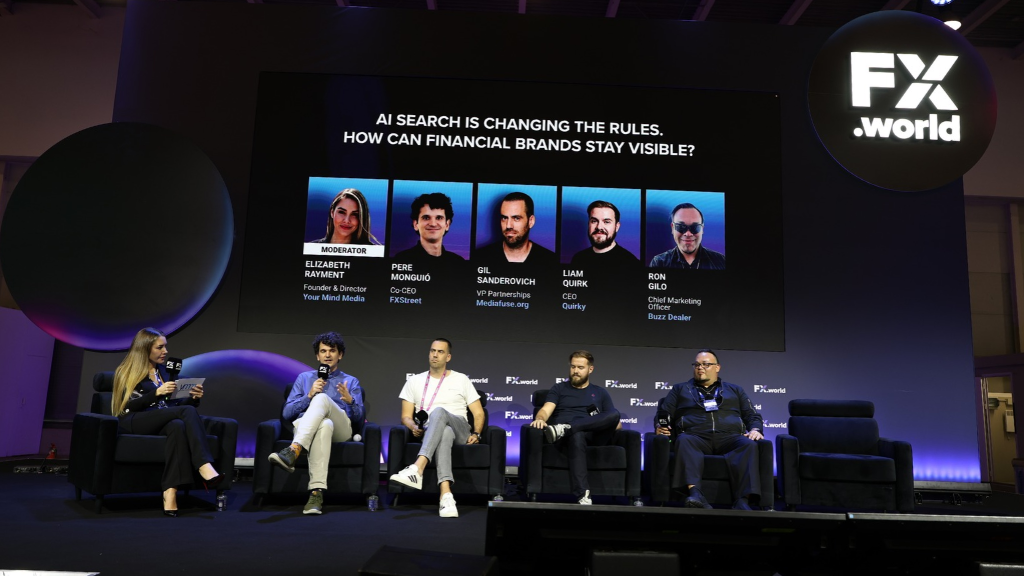
Financial brands are adapting to a world where customers increasingly turn to AI-generated answers rather than traditional search results. At FX.world Rome 2026, industry experts examined how SEO, digital PR, reputation management and content strategies must evolve, while questioning whether the effectiveness of AI visibility campaigns can yet be measured reliably.
The rise of AI-powered search is changing how consumers discover financial services, compare brokers and evaluate the credibility of brands. Instead of navigating multiple search results, prospective customers can now ask detailed questions and receive recommendations directly from an AI assistant.
For financial companies, this creates a new challenge: being visible is no longer simply about appearing on the first page of Google. Brands must also consider how they are represented in AI-generated answers, which sources inform those responses and whether their visibility translates into commercial results.
These questions shaped AI Search Is Changing the Rules. How Can Financial Brands Stay Visible?, a panel held on 4 November at the Global Finance Stage during FX World, held in Rome, on November 2026.
Moderated by Elizabeth Rayment, Founder & Director of Your Mind Media, the discussion featured Pere Monguió, Co-CEO of FXStreet; Gil Sanderovich, VP Partnerships at Mediafuse.org; Ron Gilo, CMO of Buzz Dealer; and Liam Quirk, CEO of Quirky.
The speakers agreed that AI search deserves increasing attention from financial brands. However, they also challenged the idea that success requires abandoning established SEO practices in favour of entirely new optimisation techniques.
AI search changes discovery, but SEO fundamentals remain
The panel began by examining the differences between traditional search engine optimisation (SEO) and the emerging practices often described as answer engine optimisation (AEO) or optimisation for large language models (LLMs).
Monguió argued that much of the underlying work remains unchanged. Relevant content, technical accessibility and a strong reputation still influence whether a brand is discoverable.
One important difference, however, concerns the types of searches companies need to address.
Traditional SEO often involves targeting particular keywords and analysing performance for specific queries. AI assistants introduce a more conversational approach, allowing users to describe their circumstances, preferences and concerns in considerably greater detail.
For financial brands, this means that visibility may depend less on ranking for a single keyword and more on establishing credibility across an entire category.
Quirk similarly suggested that the fundamentals of SEO remain valuable, while identifying off-page activity as an area receiving greater attention.
Mentions in established publications, independent reviews and other external sources can help shape how a business is represented beyond its own website.
Gilo agreed that third-party signals are becoming particularly important, although the panel also stressed that external visibility cannot compensate for weak or incomplete website content.

The first priority: Answer the questions customers actually ask
For Quirk, one of the most practical opportunities lies in improving the information available on a company’s own website.
He noted that customers increasingly use AI assistants to ask longer and more specific questions than they might enter into a conventional search engine.
Someone researching a forex broker, for example, may no longer search only for a broad product category. Instead, they may describe their trading requirements, concerns about security or the particular services they need.
Websites that address these questions clearly and comprehensively are better positioned to provide relevant information.
Quirk recommended examining the questions customers ask through live chats, social media and other communication channels, then ensuring that the corresponding answers are available on the website.
Monguió reinforced this point, arguing that brands should establish a strong foundation of accurate, accessible information before investing heavily in external mentions.
The discussion highlighted a straightforward principle: companies need to understand what customers want to know, rather than relying exclusively on the terminology they use to describe their products.
For financial businesses, where customers frequently compare complex services and assess potential risks, detailed and trustworthy information becomes particularly important.
Why digital PR and third-party authority matter
The conversation then moved to the role of external publications in AI-generated answers.
Sanderovich described how press releases and coverage in established financial media can contribute to a brand’s discoverability.
He argued that AI systems frequently draw on information published by recognised outlets, making accurate and relevant media coverage an important consideration for financial companies.
According to Sanderovich, both paid and organically distributed press releases may contribute to visibility when the underlying information is credible.
However, the panel did not establish that the two formats receive identical treatment across AI systems. Their use of sources can vary depending on the platform, the query and the information available.
Monguió emphasised that companies should prioritise their own content before pursuing extensive external coverage.
For commercial searches, particularly those comparing providers within a financial services category, independent mentions may become especially influential.
A company seeking visibility for questions about the best brokers or the suitability of particular financial services needs more than a technically optimised website. It also needs credible information about its products to exist beyond its own digital properties.
This creates a closer relationship between SEO, public relations and brand positioning.
Online reputation is becoming part of AI search visibility
Ron Gilo examined the growing importance of online reputation management.
He explained that information about a financial brand can appear across many sources, including review websites, discussion forums, news articles and user-generated content.
These external opinions may influence how a company is described when users ask an AI assistant to compare competing providers.
For financial businesses, such questions can be commercially significant.
Prospective customers may ask whether a broker is trustworthy, which company offers particular trading conditions or how different providers compare.
A brand that publishes comprehensive information on its own website may still struggle to influence these comparisons if its wider online reputation is weak or inconsistent.
Gilo argued that reputation management is therefore becoming more important to businesses seeking visibility in AI-generated category answers.
The panel also considered how AI search may affect customer acquisition.
Unlike a traditional search results page, which requires users to visit and evaluate several sources, an AI assistant can bring information together into a single response.
This could shorten parts of the customer research process, although the commercial impact remains difficult to establish.
The potential for stronger conversion should therefore be distinguished from verified performance. The speakers discussed encouraging experiences and expectations, but did not present independently substantiated conversion benchmarks.
AI visibility is growing faster than the tools used to measure it
One of the most revealing parts of the discussion concerned attribution.
Companies can invest in content, PR and reputation management, but how can they determine whether those activities actually generate customers through AI search?
Quirk was particularly sceptical about the current state of measurement.
He explained that existing tools can monitor selected prompts, estimate how frequently brands appear in responses and identify some referrals from AI platforms.
What remains difficult is connecting a specific optimisation activity to a customer’s complete journey, from the original AI interaction to an enquiry or commercial conversion.
A user may encounter a brand through several channels before making contact, making it hard to determine which activity influenced the decision.
Quirk also questioned the accuracy of some tools that claim to reconstruct the prompts responsible for individual visits.
Monguió identified a related problem: AI-generated responses are not necessarily consistent.
Different prompts, user contexts, models and locations can produce different answers. Measuring visibility therefore often requires repeated sampling rather than observing a fixed ranking.
Even when a company knows that it appears in AI-generated responses, translating that visibility into a reliable return on investment remains challenging.
For financial brands accustomed to evaluating SEO and performance marketing through measurable outcomes, this represents a significant limitation.
The panel warned that uncertainty creates an opportunity for providers to oversell AI optimisation services or present estimates as more precise than they really are.
Gilo nevertheless expected measurement capabilities to improve as the technology matures.
The broader conclusion was that AI visibility deserves attention, but companies should remain cautious about claims of guaranteed rankings, precise attribution or predictable commercial returns.

Practical steps financial brands can take today
Despite the uncertainty surrounding measurement, the speakers identified several actions that companies can take without waiting for the technology to mature.
Quirk highlighted a technical issue that can prevent websites from appearing in certain AI-powered discovery experiences: restrictions on automated crawlers.
He described working with an organisation whose security measures blocked relevant AI crawlers, limiting how those systems could access its content.
For businesses reviewing their AI visibility, checking crawler access is therefore an important starting point, although accessibility alone does not guarantee inclusion in AI-generated answers.
Monguió recommended developing a comprehensive knowledge base that addresses customer questions and provides reliable information about the company’s services.
Brands can then monitor commercially relevant questions, including comparisons with competitors, product suitability and concerns about credibility.
Analysing which external sources appear in AI-generated responses may help identify opportunities for additional coverage.
Sanderovich encouraged companies to consider credible press releases and relevant financial media as part of their communication strategy.
Gilo stressed the importance of investing in third-party authority rather than relying entirely on information published through a brand’s own channels.
Together, these recommendations point towards an approach built on established digital marketing principles, adapted to the ways people now search for financial information.
The next phase of search will reward credibility over shortcuts
As the discussion concluded, the panellists returned to the importance of building sustainable strategies.
Gilo argued that brands delaying investment in their wider online reputation could find themselves at a disadvantage as competitors strengthen their presence across external sources.
Quirk emphasised the need to understand the intended customer audience and align both website content and third-party activity with its actual information needs.
Sanderovich highlighted the growing importance of distinguishing financial brands in an increasingly competitive market.
Monguió offered a warning against treating AI search as a fully understood discipline.
The technology is evolving rapidly, and strategies that appear effective today may become less useful as AI models and search experiences change.
For financial companies, the immediate priority is therefore not to chase every new optimisation technique. It is to develop accurate content, maintain accessible websites, build credible external relationships and monitor emerging search behaviour without assuming that current measurement tools tell the complete story.
AI may change how people find financial services, but the qualities that make a brand worth finding remain much the same.
The discussion around AI, digital marketing and financial technology will continue at FX.world Rome in May 2027. Further details about the revised event calendar are available in the official announcement.