At FX World’s Global Finance Stage, executives from B2BROKER, LMAX Group and GTC Prime discussed how brokers can protect execution quality during market stress, why multiple liquidity providers may not guarantee diversification, and what lies ahead for multi-asset trading in 2027.
Gold has become a major driver of trading activity in 2026, creating opportunities for brokers and liquidity providers while exposing weaknesses in pricing, execution and risk management. During periods of extreme volatility, the ability to execute an order reliably can matter considerably more than the spread displayed on a trading platform.
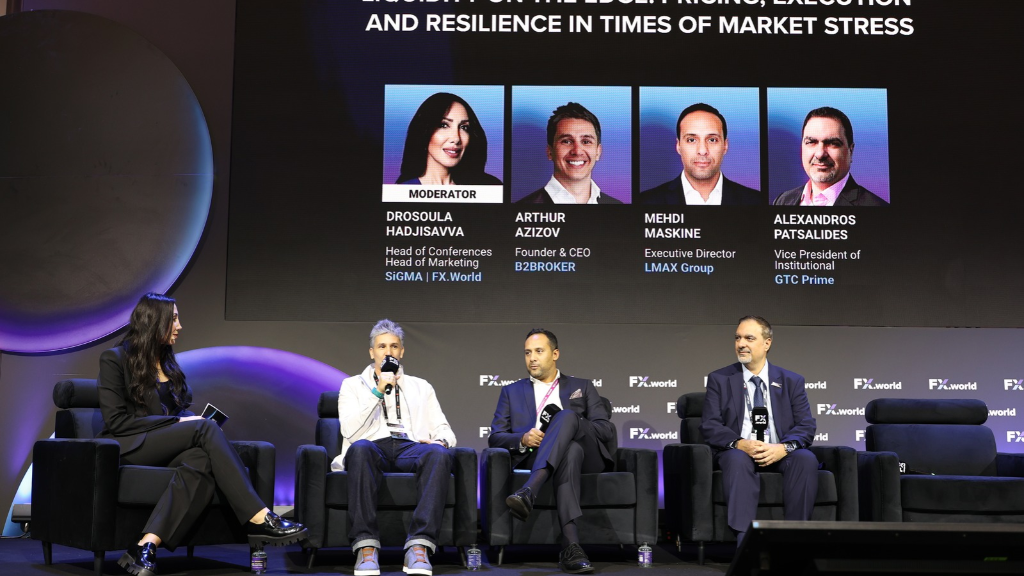
That was one of the central messages from “Liquidity on the Edge: Pricing, Execution and Resilience in Times of Market stress”, held on 04 November at the Global Finance Stage during FX World in Rome.
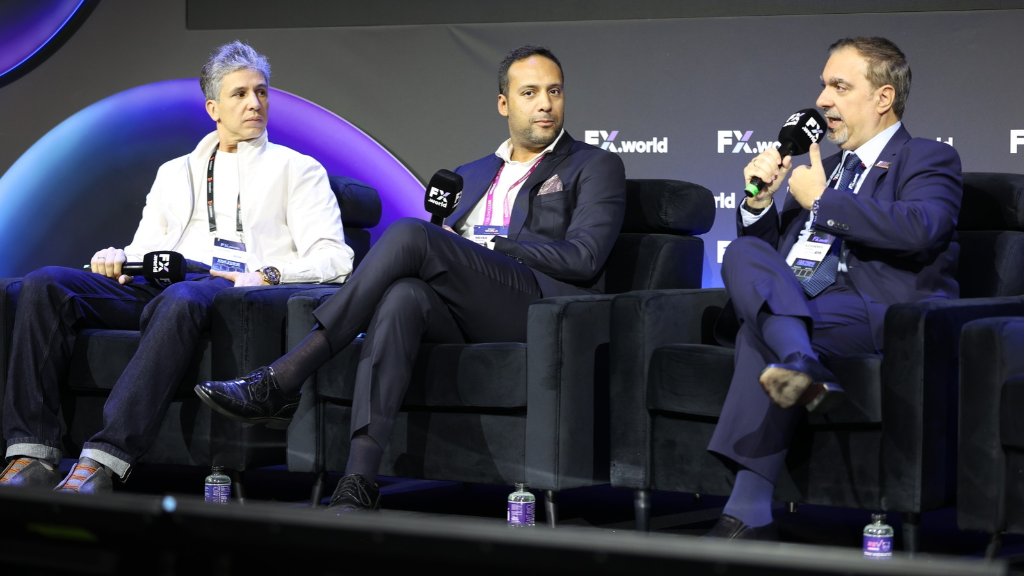
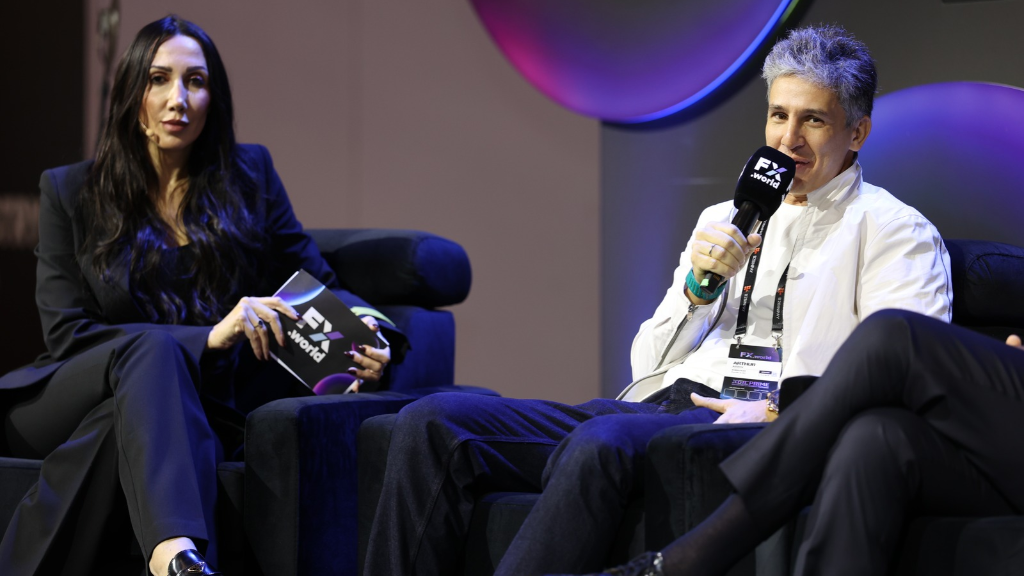
The discussion was moderated by Drosoula Hadjisavva, Head of Conferences at SiGMA and Head of Marketing at FX.World, with contributions from Arthur Azizov, Founder & CEO of B2BROKER; Mehdi Maskine, Executive Director at LMAX Group; and Alexandros A. Patsalides, VP of Institutional at GTC Group | GTC Prime.
Drawing on their experience across institutional liquidity, brokerage infrastructure and risk management, the speakers examined how financial firms have responded to turbulent markets and what brokers should consider when selecting liquidity partners.
Gold dominates trading activity, exposing concentration risks
The conversation opened with gold’s increasingly prominent role in financial markets. Traditionally considered a safe-haven asset during periods of geopolitical uncertainty, gold has experienced significant volatility, prompting questions about whether liquidity infrastructure has kept pace with the concentration of trading activity.
Azizov described gold as a major driver of trading volumes over the previous 18 months. According to figures he shared from his business, the metal had accounted for more than 80 per cent of trading volume. He argued that the industry had not been fully prepared for such a concentration of risk, particularly during the intense market conditions experienced around December 2025 and January 2026.
Banks, market makers and liquidity providers faced considerable pressure, although Azizov suggested that the experience had encouraged firms to strengthen their operations. Patsalides offered a broader perspective on safe-haven assets, noting that market preferences can shift between gold, oil, silver and other instruments depending on geopolitical and economic conditions.
For liquidity providers, he explained, volatility can generate business opportunities, but only when accompanied by sufficient controls to protect clients and manage the provider’s own exposure. The challenge is therefore not to avoid volatile markets, but to ensure that trading infrastructure remains reliable when volumes increase and liquidity becomes harder to access.
Why having several liquidity providers is not always enough
One of the clearest conclusions from the panel concerned diversification. Azizov argued that brokers should maintain relationships with more than one dependable liquidity provider, ensuring they have alternatives when their primary provider encounters difficulties. He suggested that the stress experienced in recent months had made brokers more conscious of the importance of backup arrangements and stronger relationships between their dealing teams and liquidity partners.
Patsalides supported this approach, explaining that liquidity providers must also diversify their own counterparties, including banks and non-bank institutions. He described the relationship between brokers and liquidity providers as collaborative rather than purely competitive, arguing that firms should be willing to recommend additional providers when doing so helps protect clients.
Maskine, however, highlighted an important limitation. A broker may work with five or six liquidity providers and still remain exposed to the same underlying institutions. If those providers rely on identical banks or execution venues, adding more names to the list may offer little meaningful protection.
For that reason, he advised brokers to examine the underlying liquidity infrastructure and select providers offering access to genuinely different execution venues. The distinction is critical: diversification should reduce shared dependencies, not simply increase the number of commercial relationships.
Executable prices matter more than displayed spreads
The panel then turned to the difference between the prices visible in an order book and those that can actually be executed during market stress. Maskine explained that attractive prices displayed at the top of an order book do not necessarily guarantee execution at those levels.
During volatile conditions, available liquidity may change quickly, spreads can widen and the size or characteristics of an order can influence the final execution. For brokers, the priority should therefore be access to firm, executable pricing and reliable fills rather than the narrowest advertised spreads.
Maskine also emphasised the role of experienced dealing teams in identifying trading flows and communicating effectively with liquidity providers. Azizov expanded on this point, explaining that different types of client activity require different approaches to liquidity management.
Rapid sequences of orders, particularly those targeting the top of the order book, can create execution challenges that providers must understand and manage. He described the importance of working with market makers, monitoring execution rates and creating separate liquidity pools for different types of flow.
Patsalides added that communication between brokers’ dealing teams and their liquidity partners is essential. By sharing relevant information about expected order flow, brokers can help providers adjust their pricing and liquidity arrangements more effectively.
The speakers also discussed the ability of liquidity providers operating as market makers to assume certain risks themselves, subject to their internal risk-management decisions. Rather than treating execution as a simple comparison of quoted spreads, the discussion presented it as the result of relationships, technology, market access and operational expertise.
The rise of multi-asset brokerage in 2027
Looking ahead, the conversation shifted towards the convergence of traditional financial products and digital assets. Azizov predicted that more brokers would expand beyond their traditional foreign exchange and CFD offerings to provide access to additional asset classes. He pointed to the evolution of crypto products, from CFDs to perpetual futures and spot trading, and identified securities as another area of growing demand.
In his view, 2027 could bring further development of multi-asset brokerage models as firms seek to broaden their services without abandoning their established strengths. Maskine agreed that cross-asset liquidity would become increasingly important, pointing to the expansion of services across conventional and digital markets.
Patsalides also raised the growing interest in prediction markets, although he cautioned that the infrastructure required to provide liquidity for these products is not yet clearly established. He suggested that greater industry cooperation could eventually help develop this area. The speakers additionally discussed how traditional exchanges are moving into brokerage services while brokers increasingly explore exchange-like products, payment infrastructure and tokenised securities.
This convergence could create more comprehensive financial service providers, but it also introduces operational risks. Azizov and Patsalides both stressed that diversification should not come at the expense of a company’s core capabilities. Expanding into new asset classes may be commercially attractive, but firms still need the expertise, counterparties and infrastructure required to deliver those services reliably.
Resilience begins before the next market shock
The panel concluded with a shared emphasis on preparation. The gold volatility experienced in 2026 has demonstrated that market access alone does not guarantee reliable execution. Brokers must understand where their liquidity originates, how their providers manage risk and what happens when trading conditions deteriorate.
The discussion also challenged the assumption that tighter spreads or a greater number of liquidity relationships automatically translate into better outcomes. Instead, resilience depends on dependable counterparties, diverse execution venues, experienced dealing teams and transparent communication throughout the liquidity chain.
As brokers move towards broader multi-asset offerings in 2027, maintaining those standards will become increasingly important. The message from the Global Finance Stage was clear: new products and trading opportunities may continue to emerge, but the ability to provide executable liquidity during periods of uncertainty will remain a defining test for the industry.
Explore the FX World conference programme for further discussions on financial markets, brokerage technology and institutional liquidity.