Can artificial intelligence remove the behavioural mistakes that undermine trading, or does handing over financial decisions to algorithms introduce risks that the industry has yet to resolve? A panel at FX World in Rome exposed a clear divide.
Artificial intelligence can analyse financial markets, identify patterns and generate trading signals at remarkable speed. Whether it should also be allowed to make the final decision, however, remains a contentious question.
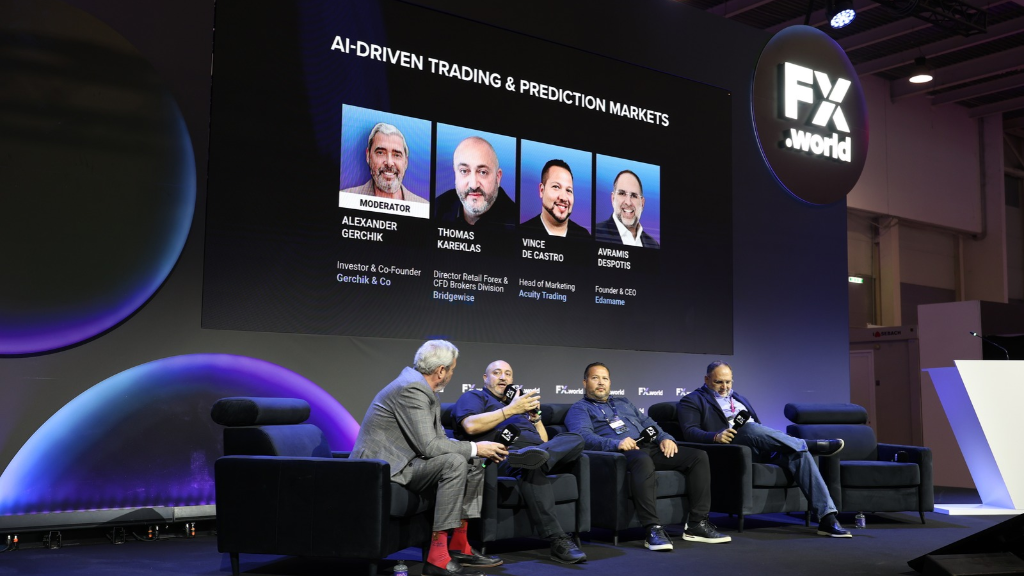
That disagreement took centre stage during “AI-Driven Trading & Prediction Markets”, a panel held on 03 November at the Global Finance Stage during FX World in Rome.
The discussion was moderated by Aleksander Gerchik, Legendary Wall Street Trader, International Investor and Co-founder & President of Gerchik & Co, who challenged the assumption that automated trading systems are already capable of replacing human judgement.
Joining him were Thomas Kareklas, Director Retail Forex & CFD Brokers Division at BridgeWise; Vince De Castro, CMO at Acuity Trading; and Avramis Despotis, Founder & CEO at Tradepedia and Co-Founder at Edamame.
While the speakers recognised the growing role of artificial intelligence in financial analysis, they offered contrasting views on automation, accountability and the continued involvement of human traders.
Should AI assist traders or replace them?
Gerchik opened the discussion by expressing scepticism about the capabilities currently attributed to artificial intelligence in trading. Drawing on his decades of experience in financial markets, he questioned whether algorithms could reliably navigate unexpected market conditions without human supervision.
Kareklas approached the issue from a different perspective, distinguishing between general-purpose AI systems and specialised financial technology.
He argued that AI can improve the trading process when it draws on appropriate financial data, uses well-designed analytical methods and remains subject to manual oversight. For him, the value lies in making sophisticated analysis more accessible without removing the trader’s ability to intervene.
De Castro raised a related concern: the distinction between explaining what is happening in a market and explaining why it is happening.
AI can produce market commentary almost instantly, but a convincing explanation does not necessarily reflect the actual causes behind a price movement. The risk becomes particularly significant during unusual market conditions, when an automated system may generate plausible answers despite lacking sufficient evidence.
Despotis presented a more ambitious case for automation.
In his assessment, one of the biggest obstacles to successful trading is human behaviour. Traders may abandon their strategies, move stop-loss orders or enter positions prematurely, even when they understand the risks.
His proposed solution was to remove much of that discretionary decision-making. Under the approach he described, AI would conduct the analysis, determine the trades and execute them, while users retained control over parameters such as capital allocation, risk tolerance and stopping conditions.
This sparked one of the panel’s most animated exchanges.
Gerchik acknowledged the psychological weaknesses of human traders but challenged the suggestion that current AI systems had demonstrated sufficient reliability to assume complete control. He pointed to the possibility of algorithms continuing to follow established patterns even when market conditions change dramatically.
The disagreement exposed a fundamental question: is human intervention an essential safeguard, or does it undermine the consistency that automated trading is designed to provide?
Data quality and explainability remain central concerns
The debate then shifted towards the reliability of AI-generated recommendations.
Gerchik asked who should bear responsibility if an autonomous trading system made an incorrect decision that resulted in substantial losses.
The discussion considered several possible safeguards, including predefined risk limits, manual intervention and the ability to interrupt automated trading. An illustrative monthly loss threshold of 20 per cent was mentioned, although the speakers also acknowledged that sudden market movements can undermine conventional risk controls.
Kareklas emphasised the importance of tracing recommendations back to their original information sources.
Using BridgeWise as an example, he described a system designed to make its financial analysis and recommendations traceable. He said the company’s technology draws on licensed data providers and provides access to analysis covering approximately 60,000 assets and more than 20 years of historical data.
He also outlined a framework combining financial, technical and sentiment analysis, with data quality and transparency intended to help traders understand the basis of a recommendation.
These figures and capabilities were presented by Kareklas during the panel rather than independently demonstrated.
For the BridgeWise executive, specialised AI systems should operate within monitored environments, with clear data provenance and mechanisms allowing users to maintain control.
The discussion did not establish a shared answer to the question of liability, particularly where responsibility could potentially be divided between traders, technology providers and brokers.
What does AI deliver for brokers and their clients?
From a broker’s perspective, De Castro questioned whether the ability to produce large volumes of financial content still provides a meaningful competitive advantage.
As AI makes market commentary and analysis increasingly inexpensive to generate, he suggested that the focus should move towards relevance, quality and measurable outcomes.
Rather than looking only at how much information a platform produces, brokers should examine how traders respond to it.
Among the measures discussed were customer lifetime value, inactivity, retention and trading behaviour following a loss. Understanding whether clients continue engaging with a platform, become dormant or return after a difficult trading period could help firms evaluate the effectiveness of their content.
These considerations also reveal an important distinction between commercial performance and outcomes for individual traders. Greater engagement or trading activity does not necessarily mean better investment results.
For brokers and financial technology providers, the challenge is therefore not simply to introduce AI tools, but to demonstrate what those tools actually improve.
Human judgement remains the dividing line
Towards the end of the session, Despotis returned to his argument that even sophisticated trading signals can lose their value when human traders disregard them.
Gerchik countered that successful automated analysis should not automatically be treated as proof that the final trading decision can safely be delegated to AI.
The exchange continued into the closing moments of the panel, with participants maintaining their different positions on the merits of human involvement.
Despite its title, the discussion concentrated predominantly on AI-assisted analysis and automated execution rather than offering a detailed examination of prediction markets.
What emerged was a more immediate debate about the direction of financial technology: whether artificial intelligence should primarily inform human decisions or increasingly make those decisions itself.
For Kareklas and De Castro, the discussion highlighted the importance of reliable information, relevant analysis and the ability to assess outcomes. Despotis placed greater emphasis on overcoming the behavioural limitations of human traders through automation, while Gerchik remained unconvinced that present-day systems could consistently replace human judgement.
No consensus emerged on the appropriate level of autonomy, or on how responsibility for automated trading losses should ultimately be allocated.
As AI becomes more deeply embedded in trading platforms and brokerage services, those questions are likely to remain central to the industry’s development.
Explore the FX World conference agenda for further discussions on financial technology, artificial intelligence and emerging market trends.