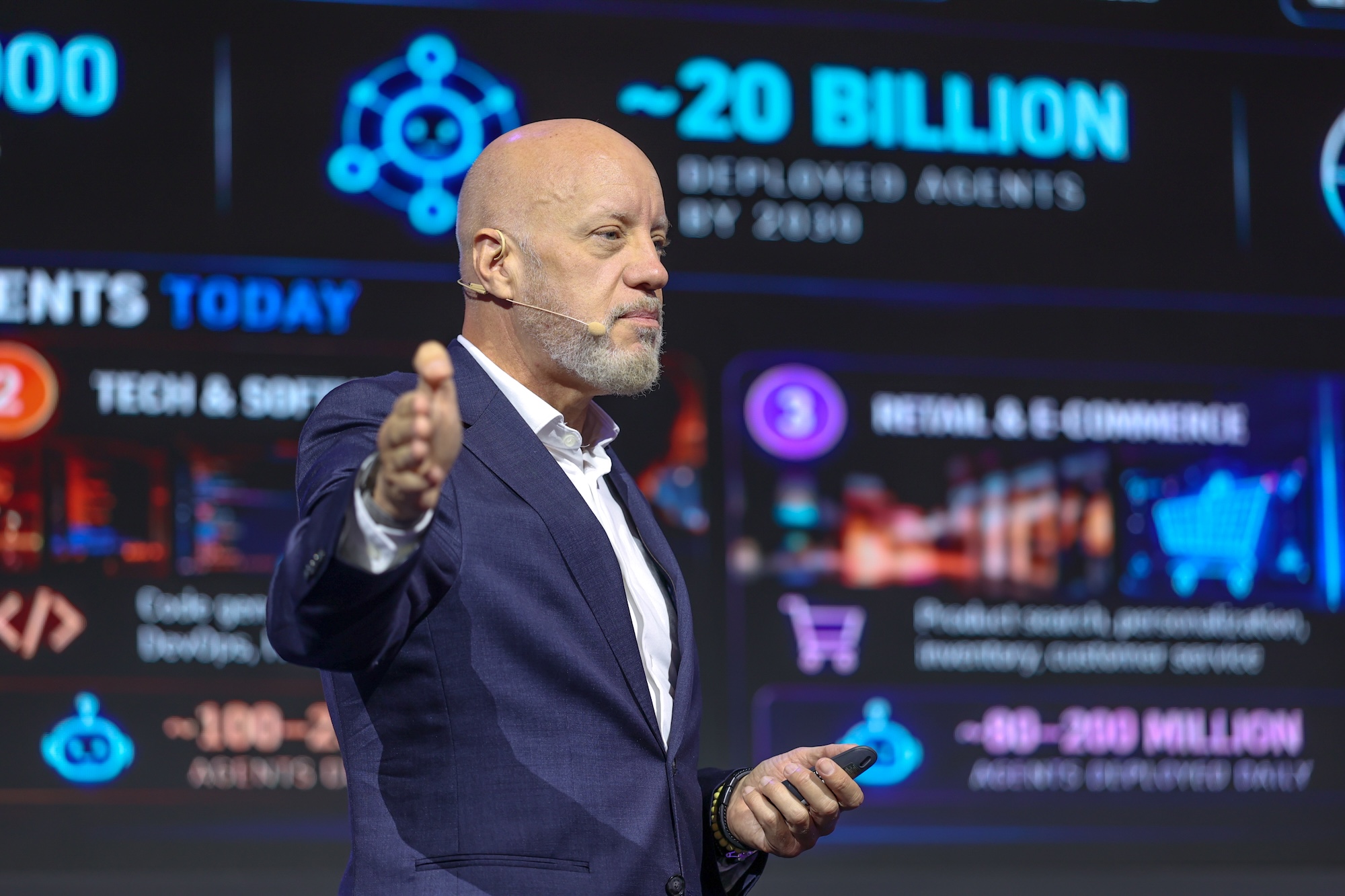
Artificial intelligence (AI) agents could fundamentally change how financial services operate, from managing money and accessing credit to executing international transactions. As these systems become more autonomous, banks will need to rethink their infrastructure, customer relationships and regulatory frameworks. This was the central message from Brett King, founder and CEO of Provoke and bestselling author, during his FX.world keynote, “Bank 5.0: The Rise of Autonomous Banking in a Smart World”.
King said the number of active AI agents could reach eight billion by 2030, with some forecasts putting the figure in the tens of billions. Unlike traditional digital banking, where customers use apps to access financial products, agentic banking would allow AI systems to act on their behalf.
“The first thing is we have to stop assuming that there’s a human at the end of the chain,” King said.
Banking built around AI agents
King argued that banks will need to move away from product-focused services towards systems that understand customers’ financial objectives.
He used buying a home as an example. Rather than approaching a bank specifically for a mortgage, a customer could tell their personal AI agent they want to purchase a property. The agent could then explore financing options and help achieve that goal.
The same approach could apply to international money transfers. A personal AI could compare available options and find the quickest way to send money overseas. At first, customers might review the options and choose how to proceed. As they become more comfortable with the technology, they could allow the agent to carry out the transfer on its own.
For this to work, banks may also need to provide accounts specifically for AI agents, alongside customers’ existing accounts. King suggested that stablecoins and crypto accounts could be used for these operations, keeping agents’ financial activity separate from customers’ other banking transactions.
Regulation must adapt to autonomous finance
The growing number of agents also presents challenges for financial supervision. King argued that existing regulatory frameworks are not designed to manage autonomous systems operating at this scale.
“Humans will not be able to regulate machines at scale,” he said.
His proposed approach involves developing regulatory infrastructure in which digital identity, data messaging capabilities, and banking policies are translated into code. This would allow automated systems to monitor financial activity and help regulators oversee transactions carried out by AI agents.
King also compared the readiness of different financial centres to adopt this model. He identified the UAE and Saudi Arabia as emerging capable authorities, while Singapore and China showed high readiness. The EU, US and UK, in his assessment, were less prepared, largely because their regulatory structures remain focused on human supervision.
For banks, the transition will require changes beyond technology. King outlined a roadmap involving organisational culture, data, intelligence, infrastructure and ecosystems, with an emphasis on becoming AI-first rather than continuing to design services primarily around human interaction.
He closed with a question about the future of established financial institutions: whether banks built on traditional models can adapt to an economy increasingly operated by autonomous systems.
“The question is no longer whether banking will change,” King said. “The question is whether any of the traditional banks that have been built on the foundation of what the Medicis built in Italy 500 years ago will survive this transition to agentic-first banking.”